Shopping Cart







Yoga equipment for your practice at home or in the studio: mats, blocks, rings, foam rollers and bands from the Steelstorm Studio range, selected for stability, durability and good value for money.
For yoga, you basically only need a mat and a bit of space. Even so, the right equipment is worthwhile as soon as you practise more regularly or want to deepen certain poses. With a non-slip yoga mat, block, ring, foam roller and resistance bands, you are well equipped for both beginner and advanced practice.
 Steelstorm Studio yoga mat
 Steelstorm Studio Foam Roller
 Steelstorm Studio Yoga Ring
 Steelstorm Studio Yoga Block
The most important points at a glance
The mat is the foundation of every session: it gives you grip, protects your joints from hard ground and creates your personal exercise space. Non-slip performance is crucial, especially when you start to sweat.
The block shortens the distance to the floor, helps with limited mobility and makes poses such as the forward fold more accessible. Here you will find the Steelstorm Studio Yoga Block.
The ring supports stretching and mobility, especially when opening up the chest and shoulders, and adds extra stability work to your practice.
For recovery after training: the foam roller releases tension in the back and legs. You will find more suitable models in our Mobility & Regeneration category.
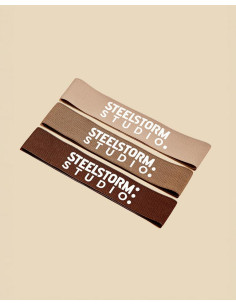
Bands add active strengthening to yoga, for example for the hips and shoulders. Start with the Mini Band Set medium + heavy or the 3-piece MiniBand Set. There is more choice among the power bands.
The ball is suitable for balance and stability exercises, also beyond classic yoga practice.
| Criterion | What to look out for |
|---|---|
| Non-slip performance | Crucial as soon as you sweat: a smooth mat quickly becomes a safety risk |
| Mat thickness | 4 to 6 mm is the usual compromise between cushioning and stable floor contact, thinner mats are easier to transport |
| Material | TPE mats are light and easy to care for, natural rubber usually offers more grip but is heavier |
| Block and ring | High-quality foam or cork keeps its shape for years, cheap products lose their shape quickly |
| Size and weight | For travelling, low weight and foldability count, for the studio it can be larger and sturdier |
For fixed training locations at home or in the studio, thicker mats and larger blocks are worthwhile, and weight does not matter here. If you practise on the go or change location often, light, foldable mats and compact tools such as a Mini Band Set are the better choice, as they fit easily into a backpack.
A mat that is 5 to 6 mm thick with good non-slip performance is ideal for getting started. A block makes many poses more accessible. Begin with 15 to 20 minutes and one to two sessions per week.
With a ring, bands and foam roller, you can deepen poses, improve mobility and stability and recover in a more targeted way. If you combine yoga with strength or endurance training, you benefit particularly from the flexibility and recovery.
Practise at a pace that feels good and listen to pain signals. If you have any complaints or pre-existing conditions, talk to your doctor or trainer first.
Yoga improves flexibility, body awareness and recovery and is therefore the ideal complement to strength and endurance training. For more intensity, take a look at our Functional Training category, and for recovery, at Mobility & Regeneration.
| Style | Character | Well suited to |
|---|---|---|
| Hatha | Calm, poses are held | Beginners, learning technique |
| Vinyasa | Flowing, movement in time with the breath | Fitness, endurance and flexibility |
| Yin | Very calm, long-held stretches | Relaxation and flexibility |
| Power yoga | Strong, dynamic | Strength and conditioning |
Breathing is a central part of yoga. Breathe calmly through your nose and let movement and breath flow in rhythm. This helps you concentrate on the pose and calm down. If you tense up in a pose or hold your breath, ease back a little.
| Yoga | Pilates | Mobility | |
|---|---|---|---|
| Focus | Posture, breathing, flexibility, relaxation | Core strength, control, posture | Joint mobility, range of motion |
| Speed | Calm to dynamic | Controlled | Controlled, often short |
| Equipment | Mat, block, ring | Mat, Pilates roller, ring | Roller, bands, block |
If you are looking for more tools, you will find them under Mobility & Regeneration, and power bands are suitable for resistance.
| You want to | This suits you |
|---|---|
| Get started | The yoga mat with good non-slip performance and a block to begin with |
| Improve flexibility | Yoga ring and foam roller |
| Strengthen and stabilise | Mini Band Set and yoga ball |
| Recover | Foam roller and tools from Mobility & Regeneration |
Yoga is an ideal complement for strength athletes and runners. It improves flexibility and body awareness and supports recovery. Plan one to two yoga sessions per week in addition to your training, ideally on rest days or after easy sessions.
| Phase | Content | Duration |
|---|---|---|
| Arriving | Observe your breathing, seated or lying down | 2 minutes |
| Warm-up | Cat-cow, shoulder circles, gentle rotation | 3 minutes |
| Main part | Sun salutation, standing and balance poses | 10 to 20 minutes |
| Finish | Forward folds, twists, final relaxation | 5 minutes |
Which yoga mat is suitable for beginners?
A mat that is 5 to 6 mm thick with good non-slip performance is ideal for getting started. It forgives small uncertainties when standing and protects your joints at the same time.
How thick should a yoga mat be?
For most people, a thickness of 4 to 6 mm is the best compromise. Thinner mats (under 3 mm) are easier to transport but offer less cushioning for exercises that put strain on the knees.
Do I need a yoga block?
Not necessarily, but beginners in particular benefit from it: the block shortens the distance to the floor and makes poses cleaner and easier on the joints to perform.
How do I clean and care for my yoga equipment?
Wipe the mat and block with a damp cloth after training, ideally with a mild, fragrance-free cleaner. Let them dry completely before rolling up or stacking them, otherwise odours can develop.
Can I practise yoga without accessories?
Yes, a mat is perfectly sufficient to get started. Block, ring and foam roller are useful additions as soon as you want to deepen your practice or work specifically on flexibility and recovery.
How often should I do yoga?
One to two sessions per week are enough to start with. Short, regular sessions often achieve more than rare long ones. If you like, practise daily for 10 to 15 minutes.
Which yoga style suits me?
Hatha is suitable for getting started, because the poses are calm and explained. If you like movement, try Vinyasa, and if you want to relax, try Yin.
When is the best time for yoga?
That is individual. In the morning, yoga activates the body, in the evening it helps you unwind. What matters is that you practise regularly.
Do I need prior knowledge for yoga?
No. With simple poses and a block, you can start even without prior knowledge.
Does yoga help with muscle tension?
Gentle stretching and mobilisation can release tension in the body. If you have persistent pain, you should see a doctor or therapist.


