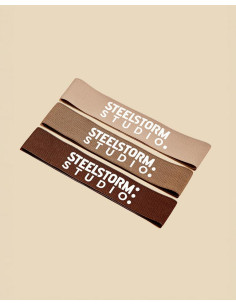
Power bands: resistance bands for strength, mobility and functional fitness
Power bands and resistance bands for strength training, mobility, warming up and rehabilitation: at PRFRM you will find bands from STRYVE, Sveltus and Steelstorm Studio in various resistance levels, from the light mini band to the strong power band.
Power bands are elastic resistance bands in different strengths. You can use them anywhere, they fit in any bag and are ideal for strength training, mobility exercises and as support for pull-ups or stretching.
The most important points at a glance
- Power bands (long, closed loops) for pull-up assistance, added resistance and stretching
- Mini bands (short loops) for hips, glutes, shoulders and warming up
- The right resistance is decisive: you should be able to complete clean repetitions without losing your technique
- Bands are light and space-saving, making them ideal for home and travel
What types of power bands are there?
Power bands
Power bands are long, closed loops. They assist you with pull-ups and dips, add resistance to squats and pressing exercises, and are excellent for stretching. Examples are the STRYVE Power Band Set and the Sveltus Power Band.
Mini bands
Mini bands are short, closed loops that you place around your thighs, knees or ankles. They activate the glutes and hips and are particularly suited to warming up before squats, deadlifts or runs. To match: the STRYVE Mini Band Set, the Steelstorm Studio MiniBand Set 3-piece and the Steelstorm Studio Mini Band Set medium + heavy.
Fitness and training bands
The all-rounders among bands: fitness and training bands in sets with several strengths let you adapt exercises individually and increase the resistance step by step. These include the STRYVE Fitness Band Set, the STRYVE Training Band 3-piece Set and the Sveltus Set of 4 Latex Bands.
What are power bands suitable for?
- Pull-up assistance: the band takes over part of your body weight, so you can build up pull-ups step by step
- Added resistance: squats, bench presses or press-ups become more intense with a band
- Mobility and stretching: with a band, shoulders, hips and legs can be stretched deeper and with more control
- Warming up and activation: mini bands prepare glutes, hips and shoulders for heavy sessions
- Rehab and prevention: light bands are suitable for controlled, joint-friendly exercises. If you have any complaints, talk to your doctor or therapist first
How to find the right resistance
| Goal |
Recommendation |
| Getting started and mobility | Light to medium resistance: a clean movement pattern is the priority |
| Pull-up assistance | Strong band to start, then switch to weaker bands step by step |
| Activation and warm-up | Mini band with light to medium resistance, 10 to 15 repetitions |
| Strength building with added resistance | Medium to strong resistance; the end of the set should feel hard, but your technique should stay clean |
| Multiple goals | A set with several strengths covers all uses |
Choose the resistance so that you can complete the planned repetitions with clean technique. Colours and strengths differ by manufacturer, so check the details on the respective product page.
Care and safety
- Check your band before every workout for cracks, stretch marks and thin spots
- Do not use the band on sharp edges or rough surfaces
- Protect bands from direct sunlight, heat and harsh cleaning agents
- Control the band when releasing it so that it does not snap back
- Replace damaged bands immediately
Power bands in your training plan
Bands complement any workout, whether Functional Training, Strength training or Yoga. For recovery and greater flexibility, you will find suitable additions in the Mobility & Regeneration category.
Exercises with power bands
| Exercise |
Band |
Trains |
| Pull-up assistance | Power band (long) | Back, biceps |
| Glute bridge with mini band | Mini band | Glutes, hips |
| Lateral steps | Mini band | Glutes, outer hips |
| Pull-apart | Power band | Upper back, rear shoulders |
| Face pull | Power band | Shoulder, upper back |
| Squat with band | Power band or mini band | Legs, glutes |
Full-body workout with bands
- Squat with mini band, 15 repetitions
- Glute bridge with mini band, 15 repetitions
- Row with power band, 12 repetitions
- Pull-apart, 15 repetitions
- Press-ups with band across the back, 8 to 10 repetitions
- 3 rounds, 45 seconds rest between rounds
Choose the resistance so that the last repetitions are hard but your technique stays clean. If you have any complaints or pre-existing conditions, talk to your doctor or therapist first.
Learning pull-ups with a band
| Phase |
Approach |
| 1 | Hook in a strong band, place your knee or foot in the loop and practise pull-ups with control |
| 2 | Switch to a weaker band as soon as you can manage 8 to 10 clean repetitions |
| 3 | Train with the weakest band and add negative repetitions |
| 4 | Without a band: try your first pull-ups and top up with bands |
Hook the band in securely and make sure the bar is stable.
Power bands, dumbbells or machines?
|
Bands |
Dumbbells |
| Resistance | Increases with stretch | Constant |
| Space and transport | Very light and compact | More space and weight |
| Use | Warming up, mobility, rehab, added resistance | Muscle building, heavy sets |
| Joint load | Low | Depends on the exercise |
Bands are an ideal complement to Dumbbells and Kettlebells, especially in a home gym.
Avoiding typical mistakes
- Band too strong: your technique suffers, so choose a suitable resistance
- Releasing the band abruptly: control the return movement
- Continuing to use a faulty band: replace damaged bands immediately
- Only one strength: a set with several strengths covers more exercises
Which band suits which goal?
Bands in your training plan
- Before training: 5 minutes of activation with a mini band for glutes and hips
- In strength training: bands as added resistance for squats and pressing exercises
- After training: stretching with a band for shoulders, chest and the back of the legs
- On rest days: light mobilisation with a band
Care and lifespan
- Wipe bands down after training and store them dry
- Avoid direct sunlight, heat and sharp edges
- Check regularly for cracks, stretch marks and thin spots
- Replace damaged bands immediately
FAQ: frequently asked questions about power bands
What is the difference between a power band and a mini band?
Power bands are long, closed loops for pull-up assistance, added resistance and stretching. Mini bands are short loops that you place around your thighs or ankles, mainly for glute and hip activation.
Which band do I need for pull-ups?
A power band is suitable for pull-up assistance. Start with a stronger band and switch to weaker ones as your strength grows.
How do I choose the right resistance level?
The resistance should be chosen so that you can perform the planned repetitions cleanly. For beginners, a set with several strengths is usually the best choice.
Can I build muscle with power bands?
Yes. Bands provide increasing resistance throughout the movement and are suitable both as a complement to dumbbells and for training at home. Progressive overload and clean technique are what matter.
How do I care for my bands?
Wipe them down after training, store them dry and protect them from sunlight, heat and sharp edges. You should replace damaged bands immediately.
Are power bands suitable for beginners?
Yes. Bands are joint-friendly, easy to dose and simple to use. Start with light to medium resistance and focus on technique.
How long does a power band last?
That depends on use, care and material. Check the band regularly for cracks and replace it immediately if it is damaged.
Can I combine bands and dumbbells?
Yes. Bands increase the resistance at the end of the movement, for example in squats or pressing exercises, and complement dumbbells well.
Which bands are suitable for warming up?
Mini bands with light to medium resistance are well suited to activating glutes, hips and shoulders.
Are bands also suitable for seniors?
Yes, light bands are suitable for gentle, controlled training. If you have any complaints, talk to your doctor or therapist first.